For those who love electronics, tinkering with circuits, or even repairing gadgets, soldering is more than a skill—it’s a creative adventure. But while you’re busy perfecting your craft, you might be exposing yourself to invisible dangers lurking in the smoke produced during soldering. Solder fumes typically contain flux smoke, tiny airborne particulates, and sometimes hazardous compounds like rosin, lead, and other toxins. Long-term exposure can lead to respiratory issues, eye irritation, headaches, and more severe health risks. The good news is: you don’t have to compromise your health for your hobby.
Building your own 12V DIY solder fume extractor is easier, cheaper, and more effective than you might think. With a few readily available parts and some basic building skills, you can set up the ultimate smoke absorber—a working fan system tailored for your soldering station.
**Why Do You Need a Fume Extractor?**
Let’s start with the basics. Soldering produces smoke, primarily from flux, that’s meant to clean and protect the metals during the process. However, this smoke contains organic acids, aldehydes, and resins that irritate the mucous membranes and respiratory tract. If you’re using lead-based solder, you could also be inhaling traces of lead. Whether you solder occasionally or daily, reducing exposure is critical.
A fume extractor actively sucks away the smoke, channels it through a filter, and prevents these toxins from entering your lungs. Unlike passive ventilation (open windows, fans), a targeted fume extractor provides localized protection exactly where you need it.
**Benefits of a DIY 12V Solder Fume Extractor**
- **Health Protection:** Significantly lowers exposure to harmful particulates and fumes.
- **Customizable:** You can tailor the size, suction power, and filter quality to your workspace and needs.
- **Portable & Flexible:** A 12V system can be powered by an adapter or battery, allowing maximum mobility.
- **Cost Effective:** DIY units cost a fraction of commercial extractors and allow for easy maintenance and upgrades.
**Core Components Explained**
A basic DIY solder fume extractor consists of a few essential elements:
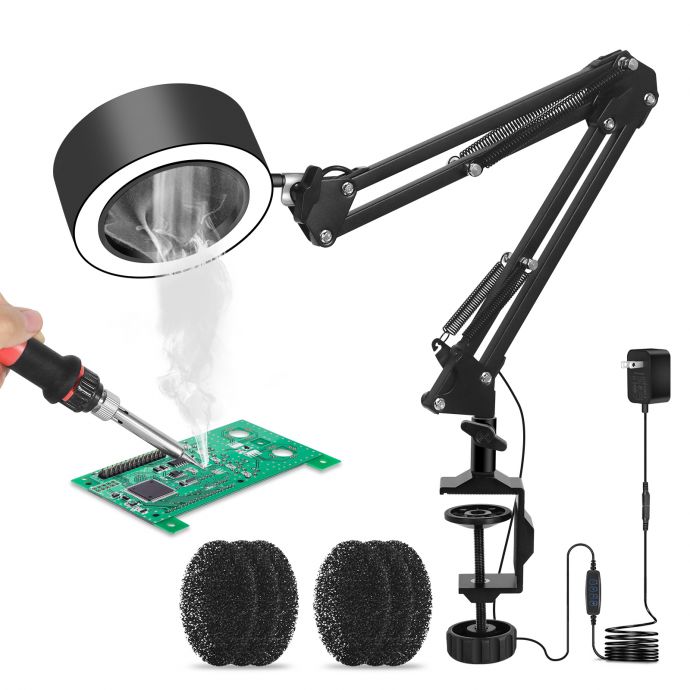
1. **Fan (12V):** Usually a DC brushless computer fan, sized typically between 80mm to 140mm. It provides steady airflow to draw smoke away.
2. **Filter:** Activated carbon filter or HEPA filter, or a combination. This traps particulates and absorbs harmful gases.
3. **Enclosure/Housing:** Holds the fan and filter, channels airflow, and is easy to position.
4. **Power Supply:** A 12V DC adapter or battery pack. Many makers use spare laptop adapters or inexpensive wall plugs.
5. **Switch & Wiring:** Basic controls for turning the system on and off, with safe, tidy wiring.
**Choosing the Right Fan**
Your fume extractor’s effectiveness depends largely on the fan. Computer cooling fans are favored for their quiet operation, steady airflow, and availability. For soldering, a fan rated between 80 to 120 cubic feet per minute (CFM) is ideal.
- **Size:** 120mm fans are standard for desktop extractors; larger if you have a spacious workspace.
- **Airflow:** More airflow means quicker smoke removal but can be noisier.
- **Voltage:** Make sure your fan matches the power supply—12V fans are widely available.
- **Bearing Type:** Ball bearing fans last longer and work well in various orientations.
**Filter Types**
- **Activated Carbon:** Best at absorbing organic gases and odors from flux smoke.

- **HEPA:** Efficient at trapping tiny airborne particulates and dust.
- **Hybrid Filters:** Combine carbon and HEPA layers for full protection.
You can purchase ready-cut filters or cut larger sheets to fit your extractor. It’s important to replace filters every few months, depending on usage.
**Designing the Housing**
The housing serves three purposes: mounting the fan and filter, directing airflow, and making the unit easy to use. Many DIY enthusiasts use plastic project boxes, repurposed food containers, or even create enclosures using 3D printing. The critical part is ensuring air flows through the filter and doesn’t bypass it.
- Position the filter directly in front of (or behind) the fan, so all smoke must pass through.
- Include a secure mounting system (clips, frames, screws) for easy filter replacement.
- Make the housing stable on your desk and easy to angle toward the workpiece.
**Wiring and Controls**
A basic ON/OFF switch, wired inline to your fan, adds convenience. For more advanced builds, you can use PWM speed controllers to adjust suction power or add indicator LEDs. Use shrink tubing or insulated connectors for safety.
**Powering Your Extractor**
Most fans are rated for 12V DC. You can use:
- A wall power adapter (with sufficient amperage for your fan).
- A battery pack (for portable use; consider lithium-ion packs for longer runtime).
- USB connections (if fan supports 5V or you use a step-up converter).
Always match the fan’s voltage and power needs. Over-voltage can damage the fan; under-voltage reduces effectiveness.
**Step-by-Step DIY Build Guide**
Here’s a sample project—a desktop 12V solder fume extractor you can build in one afternoon.
**Materials:**
- 1 x 120mm 12V brushless fan (approx. 80-100 CFM)
- 1 x activated carbon filter (or hybrid filter)
- 1 x plastic project box or suitable enclosure
- 1 x 12V DC power adapter (1A rated)
- 1 x ON/OFF switch
- Wiring (18-22 gauge), shrink tubing, connectors
- Optional: PWM controller, LED indicator
**Tools:**
- Soldering iron (for wiring)
- Small drill or Dremel tool
- Hot glue gun or epoxy
- Screwdriver, pliers, wire cutter
- Multimeter (for testing connections)
**Instructions:**
1. **Prepare the Enclosure:**
Drill or cut a hole sized for the fan on the enclosure’s face. Include mounting holes for screws or clips. Cut another slot for the filter placement.
2. **Mount the Fan:**
Secure the fan to the enclosure with screws or hot glue. Orient it so the airflow is directed outward (pulls air from workspace, through filter, then out).
3. **Insert the Filter:**
Position the filter directly over the intake (or exhaust) side of the fan. Hold it in place with clips, a frame, or a removable cover. Ensure all airflow passes through the filter.
4. **Wire the Power:**
Connect the fan to the switch, then wire to the power adapter connection. Use shrink tubing to insulate joints. If you’re adding a PWM controller or LED, wire these between the switch and the fan.
5. **Testing:**
Plug in your adapter. Switch the extractor on. Place your soldering iron near the extractor intake and note how the smoke is drawn away.
6. **Finishing Touches:**
Mark filter replacement dates. Optionally, add a handle or stand to angle the extractor toward your projects.
**Usage Tips**
- Position the extractor so its intake is 5-10 cm from your soldering worksite—the closer, the more effective.
- Replace or refresh filters every 2-3 months, or sooner if you notice reduced airflow or persistent odors.
- Clean the fan blades occasionally to prevent dust buildup and maintain performance.
- Store your extractor away from moisture and extreme heat.
**Advanced Upgrades**
If you’re comfortable with electronics and want extra features, consider these:
- **Speed Controls:** Add a PWM controller to adjust fan speed and balance suction vs. noise.
- **Digital Display:** Install a small voltmeter or airflow sensor.
- **Articulating Arm:** Build a movable stand or mount, so you can position the extractor precisely.
- **Dual Fans:** For larger workspaces, use two fans side by side with a bigger filter.
- **Smart Features:** Integrate remote control or automatic switching (motion or smoke sensor driven).
**Commercial vs. DIY: The Comparison**
While commercial fume extractors offer plug-and-play convenience, most entry-level models use similar fans and filters but at a much higher price. DIY extractors have several advantages:
- **Cost:** You can build a reliable system for $20-$40, compared to $80-$200 commercially.
- **Maintenance:** Easy, inexpensive filter replacements.
- **Customization:** Shape, size, airflow, and filter choices tailored to you.
- **Learning:** Building your own promotes hands-on skills and understanding of airflow, filtration, and basic electronics.
**Health, Safety & Peace of Mind**
Regardless of your soldering frequency, protecting your lungs and workspace from toxic fumes should be a priority. A functioning fume extractor not only safeguards your health but also enhances your soldering experience, letting you focus on precision and creativity instead of worrying about invisible hazards.
Remember, good ventilation is still important. Using your DIY fume extractor in tandem with open windows, desk fans, or room air purifiers provides added protection. Always wash your hands after soldering and store solder and flux safely.
**Conclusion**
Building a 12V DIY solder fume extractor is a smart investment—in both your craft and your wellbeing. With a modest selection of parts and a bit of ingenuity, you’ll enjoy cleaner air, sharper focus, and more productive projects. As you master soldering techniques, let your workspace reflect your commitment to both excellence and safety.
Try building your own extractor today, and breathe easy as you bring your electronic creations to life.